
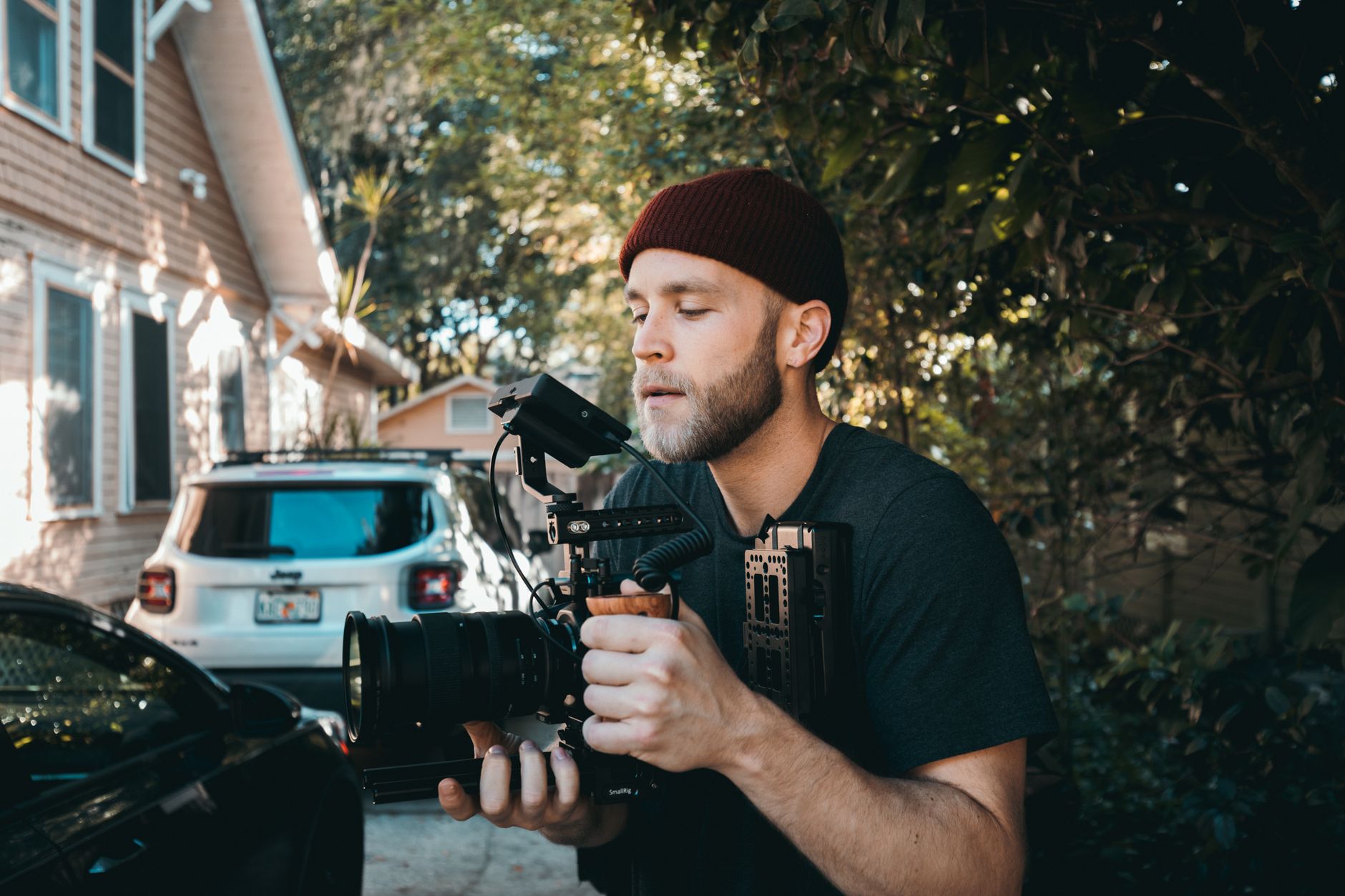
The mockumentary is one of cinema's most technically demanding formats. It borrows every convention of non-fiction filmmaking, the handheld camera, the talking-head interview, the ambient sound, and deploys them in service of a complete fabrication. When it works, audiences don't just suspend disbelief. They forget the contract entirely.
Getting there requires a very specific kind of discipline. The filmmakers behind the best mockumentaries aren't just writing jokes or shooting scenes. They're constructing a parallel reality governed by its own internal logic, where every production decision reinforces the illusion rather than puncturing it.
Where the format came from
Mockumentary has genuine roots. Robert Flaherty's 1922 Nanook of the North staged sequences presented as direct observation, which gave later filmmakers a template for controlled reality. The form got its sharpest early workout in the 1960s and 1970s with the rise of cinéma vérité, which itself blurred the line between captured and constructed footage.
Rob Reiner's This Is Spinal Tap (1984) is the film most credited with codifying the modern mockumentary. Reiner and the cast improvised extensively within a framework, using the documentary format not as parody but as an authentic structural choice. The result felt like a real band documentary precisely because nobody was winking at the camera.
That restraint is the key. The moment a character acknowledges the absurdity of their situation, the spell breaks. The best mockumentaries trust their premise completely.
The visual grammar that sells the illusion
Documentary cinematography has its own set of conventions. The camera is late to a reaction. Lighting is imperfect. The frame occasionally loses a subject as they move through a space. These aren't mistakes. They're signals to the audience that the footage is observational rather than staged.
Mockumentaries replicate this grammar precisely, which is harder to do intentionally than it sounds. A professional crew trained to anticipate action and hold a clean frame has to actively suppress that training. The art director has to dress sets to look lived-in but not too lived-in. The gaffer has to light scenes to look like available light without actually using available light, because available light is rarely usable on its own.
The talking-head interview is the format's most powerful tool. It allows characters to reflect on events the audience hasn't yet seen, building dramatic irony into the structure. It also gives the filmmakers a way to deliver exposition that feels like testimony rather than plot delivery. Voice-over narration in conventional film performs a similar function, but the talking head adds a face and a location, grounding the information in something tangible.
Why comedy found the mockumentary first
The format became dominant in comedy before it crossed into drama. Best in Show (2000), The Office (2001 in the UK, 2005 in the US), and Parks and Recreation (2009) all used the documentary frame not to parody documentary but to give their characters somewhere to put their interior life. The camera became a confessional.
That confessional quality works particularly well in comedy because it externalises subtext. Two characters can behave perfectly normally in a scene together, and then each deliver contradictory accounts to the camera. The gap between the public performance and the private account is where most of the comedy lives.
Drama has been slower to adopt the format, but when it does, the effect can be more unsettling than any straight-faced thriller. Christopher Guest's mockumentary films use extended improvisation within carefully structured outlines, which gives performances an authenticity no scripted scene can fully replicate. The actors don't know the other character's lines because there are no other character's lines.
The challenge of casting
Casting a mockumentary demands something different from conventional film. The performer has to be fully believable as a real person rather than a character. That's not just a matter of naturalistic delivery. It requires the actor to internalise a history, a set of habits, a physical self-consciousness. They're not playing someone who exists in a world. They're playing someone who exists in this world, right now, aware of the camera.
The screen test process for this kind of work is unusual. Screen tests usually assess how an actor reads within a scene; for a mockumentary, directors often need to see how a performer responds to direct address, how they handle silence, and whether they can appear to remember something rather than say something.
When the format crosses into horror
The found-footage horror film is a specific evolution of the mockumentary. The Blair Witch Project (1999) used the format to imply that the footage was recovered rather than made, which pushed the audience's suspension of disbelief to its limit. The marketing campaign treated the film as genuine missing-persons documentation.
That campaign worked because it exploited a genuine ambiguity. The visual conventions of documentary film are now so deeply internalised that audiences read handheld footage as real without thinking about it. Horror filmmakers have used that automaticity deliberately ever since. Paranormal Activity (2007) stripped the format down even further, removing the camera operator entirely and presenting security and personal camera footage as its primary material.
The horror mockumentary also exposes one of the format's structural weaknesses. The more threatening the situation becomes, the less plausible it is that a character would still be filming. Every found-footage film has to solve this problem. The solutions range from the practical (professional camerapersons who stay rolling on instinct) to the supernatural (the camera operates independently of human will).
The production design challenge
Authentic documentary footage is full of imperfection: mismatched colour temperatures, slightly soft focus, background noise that obscures dialogue. Recreating this in post-production is a craft in its own right. Colourists on mockumentary projects often work backwards, introducing the kind of inconsistency that a normal grade would remove. Colour grading in conventional film builds a unified emotional palette; in a mockumentary, the grade has to break that unity convincingly.
Sound design presents the same inverted challenge. Documentary sound is rarely clean. There's room noise, clothing rustle, wind on an exterior. A mockumentary that sounds too clean loses its textural credibility, but one that sounds too dirty becomes unwatchable. The mix has to find a register that reads as imperfect without becoming uncomfortable.
What the format reveals about storytelling
The mockumentary is useful to think about precisely because it makes the machinery of storytelling visible. Every convention it borrows from documentary has a function. The function was originally truthfulness. In a fiction context, the same conventions produce the appearance of truthfulness, which turns out to be just as useful for audiences.
What the format teaches is that believability isn't about accuracy. It's about consistency. A world that follows its own rules, even fictional ones, feels real. A world that breaks its rules, even accurate ones, feels false. The mockumentary just makes this principle unusually legible because the rules it's following are borrowed from a mode of filmmaking the audience already trusts.
The filmmakers who've pushed the format furthest are the ones who took that trust seriously. They didn't reach for it ironically. They used it as a tool, and they were disciplined about never letting the seams show.