The establishing shot arrives before any dialogue, before any character, and before any conflict. It's the frame that orients an audience in space, locks in a sense of scale, and signals the emotional register of everything that follows. It sounds simple. The craft behind a great one is anything but.
Most viewers don't consciously register establishing shots. That invisibility is precisely the point. When a wide shot of a rain-drenched city rooftop opens a scene, the audience absorbs geography, weather, time of day, and mood in about three seconds. No narration needed. No title card. The image does all of it.
What an establishing shot actually does
The primary job is spatial orientation. Before a scene can develop, the audience needs to know where the characters are in relation to each other and their environment. An establishing shot creates that mental map. A cramped apartment tells a different story to a sun-drenched suburb, even if the dialogue is identical.
But the best establishing shots do something beyond geography. They carry an argument. David Fincher's opening aerial of Los Angeles in Fight Club doesn't just say "we're in a city." It tracks through neon and concrete with a feeling of anonymous dread that the whole film is about to justify. The location and the camera's attitude toward it arrive together.
Tone is set here, before an actor opens their mouth. This is why cinematographers and directors spend real time on establishing frames. Get the opener wrong and the audience spends the next five minutes recalibrating. Get it right and they lean in.
Types of establishing shots and when to use them
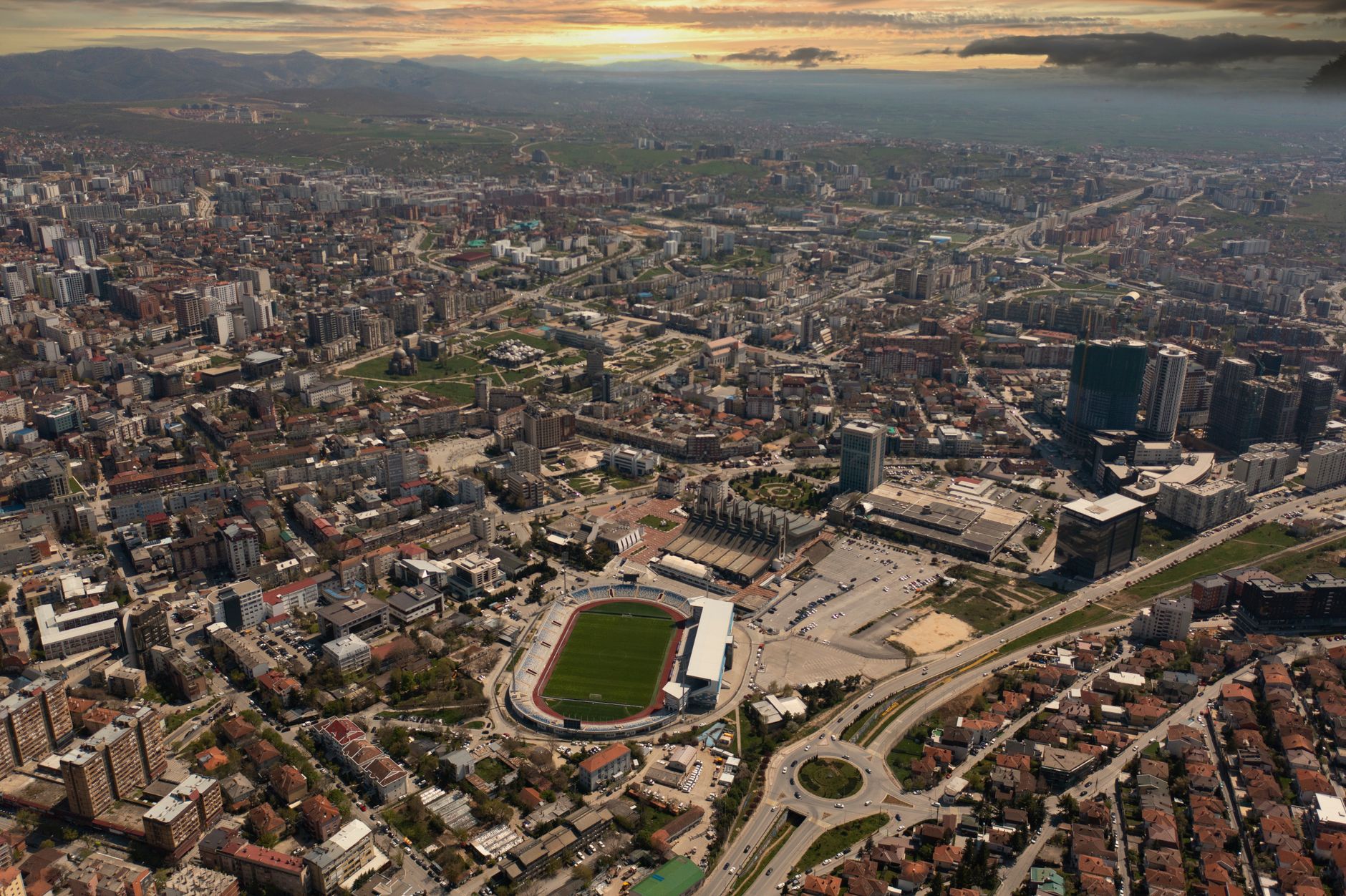
The most common form is the wide exterior: a building, a street, a landscape. It's the establishing shot that television has trained audiences to recognise instantly. You see the outside of the hospital, then you cut to the ward. The geography is established in two shots.
But establishing shots don't have to be wide. Sometimes an extreme close-up of a specific object establishes a setting more precisely than any exterior could. A military dog tag tells you more about the tone of the scene than a generic helicopter shot of a base. The object does the contextual work that geography alone can't.
Point-of-view establishing shots hand orientation directly to the audience through a character's eyes. They're more subjective and carry inherent bias: we see the world the way the character sees it, which immediately positions us emotionally. It's a technique used to strong effect in horror, where an establishing POV from inside a doorway implies threat without showing a single monster.
Re-establishing shots serve a different purpose. After a scene has developed through cuts, a wide shot returns to remind the audience of the spatial layout. They're most useful in action sequences where geography has become disorienting, or in long dialogue scenes where a return to the wider frame gives audiences room to breathe.
How location scouting shapes the establishing frame
The establishing shot is only as strong as the location that fills it. This is why location scouting and the choosing of place is one of the most consequential pre-production decisions a filmmaker makes. A location scout isn't just looking for visual interest. The scout is looking for a place that supports the establishing argument the film needs to make.
The texture of a building facade, the angle of afternoon light through a narrow street, the particular chaos of a certain intersection: these are the raw materials the establishing frame assembles. No amount of camera craft retrieves a location that was wrong from the start.
The relationship between establishing shots and cinematography
Lens choice matters enormously in establishing work. A wide-angle lens exaggerates depth and makes environments feel larger, sometimes more threatening or isolating. A telephoto lens compresses distance, flattening the relationship between foreground and background and making a city feel dense and crowded without a single person in frame.
Movement adds another layer. A slow aerial descending into a location conveys arrival, sometimes inevitability. A handheld establishing shot introduces instability before any character has acted. A locked-off, perfectly still wide shot carries stillness as a value judgment: this place doesn't move, and neither, perhaps, will the character trapped inside it.
These decisions connect directly to the broader principles of how camera work shapes storytelling at every scale. The establishing shot is where those principles are applied with the least dialogue support and the highest stakes, because there's nothing else in the frame to compensate for a weak choice.
When filmmakers break the convention
Some of the most memorable openings in cinema deliberately subvert the establishing shot. Instead of location, they give you an object. Instead of exterior, they start inside a mind. The disorientation is the point.
Memento opens without spatial orientation because spatial orientation is irrelevant to a character who can't form new memories. Mulholland Drive drops audiences into a jitterbug contest with no establishing frame because Lynchian logic requires that geography only exists to be pulled away. In both cases, the absence of the conventional establishing shot is itself the statement.
These choices work precisely because the establishing shot is so deeply embedded in cinematic grammar that breaking it registers as a signal. The audience doesn't consciously think "there was no establishing shot here." They feel unmoored. The filmmaker has chosen to do that deliberately.
Establishing shots in television and streaming formats
Television has a long and economical relationship with establishing shots. On a tight shooting schedule, a single exterior establishing shot of a hospital, precinct, or courtroom does enormous work across an entire series. Once the audience has been shown the building in episode one, a brief glimpse of the facade in episode six is enough to trigger full spatial recall.
Streaming dramas have complicated this. With episodes sometimes running 70 minutes and production budgets comparable to film, showrunners have more room to treat establishing sequences as set pieces in themselves. The showrunner's control over the visual language of a series now extends to decisions about establishing grammar: how long to hold the wide, when to return to it, and how much the location itself should carry the scene's emotional weight before any actor enters frame.
What the establishing shot teaches about visual storytelling
There's a discipline embedded in the establishing shot that applies well beyond cinema. Any visual story, whether a corporate video, a documentary, or a short film, benefits from the same question: before any message lands, does the audience know where they are?
The establishing frame is an act of generosity toward the viewer. It says: I know you don't live in this world yet. Let me show you the door before I open it. That gesture of orientation, applied with craft and intention, is what separates scenes that feel immediate from scenes that take three minutes to warm up.
Great filmmakers know the establishing shot isn't overhead. It's architecture. Every scene that follows is built on what that first frame decides to show, and what it decides to leave out of view.