
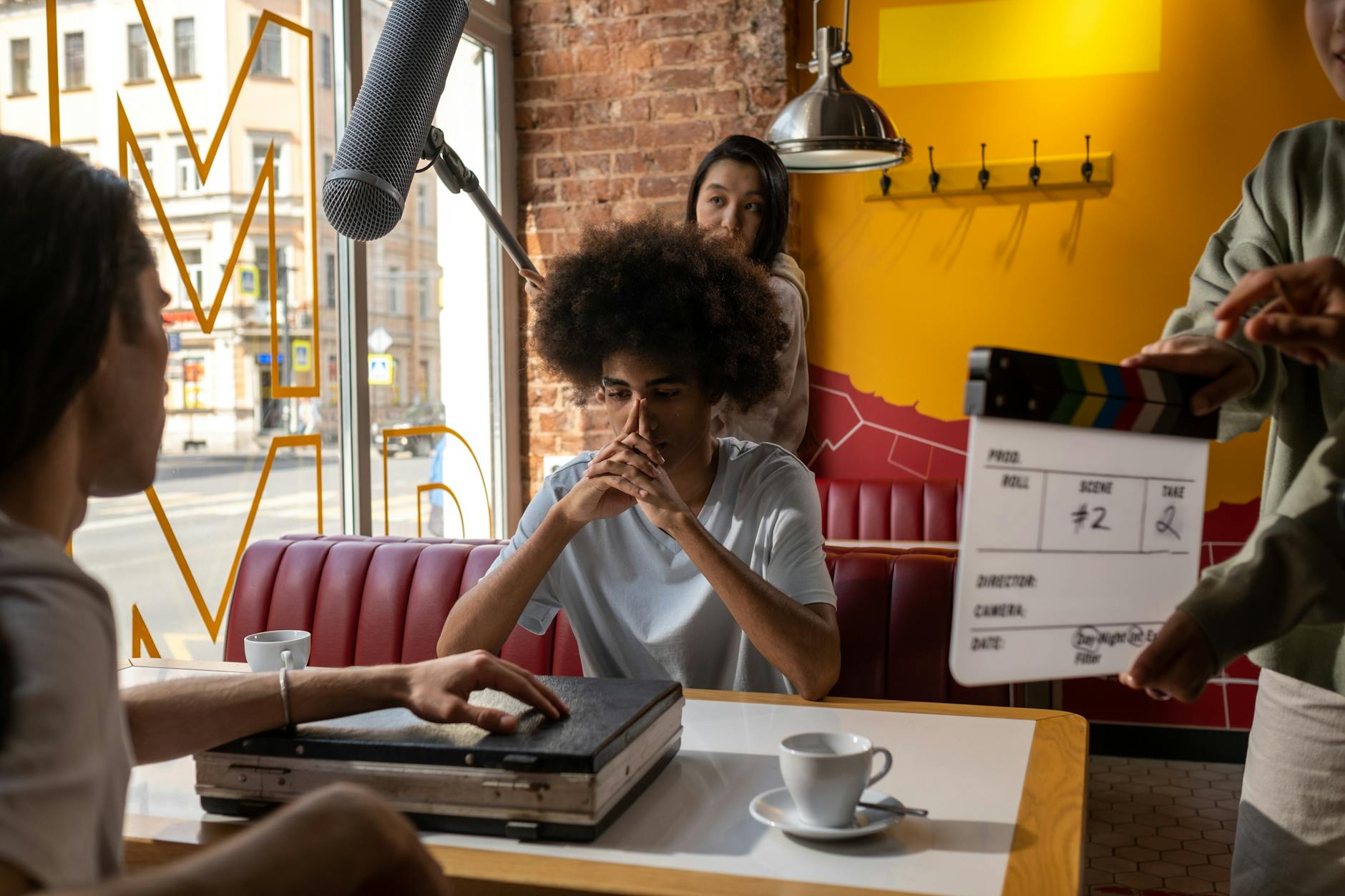
Improvisation in film occupies a strange position: directors fear it and seek it out at the same time. The improvised scene is where a performance can suddenly become real, where a line that wasn't in the script lands harder than anything a writer planned. It's also where a production can lose an entire afternoon to footage it can't use. The craft lies in building the conditions where the right kind of spontaneity can happen.
What improvisation actually means on a film set
Most people picture improvisation as an actor abandoning the script entirely and winging it. That rarely happens. What actually occurs on professional productions is closer to structured deviation: the scene has a clear dramatic purpose, the beginning and end points are fixed, and the actor finds a new path between them. Directors like Mike Leigh build entire films this way, running actors through months of character development before a camera rolls. The improvisation, by that stage, isn't random. It's deeply informed.
There's a meaningful difference between a scripted scene that's been loosened up and a genuinely unscripted exchange. The former is far more common. A director might tell an actor to "find the moment" within a rehearsed framework, or deliberately withhold a scripted line from one performer so the other's reaction stays genuine. These are controlled conditions. The spontaneity is real; the chaos isn't.
Why some directors build improvisation into the process
The argument for improvisation isn't that it's cheaper or faster. It isn't. Takes multiply, editors face more coverage, and continuity becomes a serious problem when a prop moves differently in every version of the same scene. The argument is about truth. Actors who discover a moment rather than executing one tend to find a physical, involuntary quality that scripted performance sometimes doesn't reach.
Christopher Guest has built an entire career on this principle. His ensemble films, from This Is Spinal Tap to Best in Show, operate from outlines rather than scripts. The actors know their characters' histories, motivations, and relationships, but not the specific words they'll say. The results depend entirely on the ensemble dynamic, which is why the way group dynamics function within ensemble casts matters so much to whether the approach succeeds or falls flat.
Other directors use it more selectively. David Fincher is known for running dozens of takes, not to find improvisation but to exhaust performance artifice until something instinctive surfaces. It's the opposite method arriving at a similar destination.
Famous moments that weren't in the script
Some of cinema's most quoted lines weren't written by anyone. Dustin Hoffman's repeated "I'm walking here!" in Midnight Cowboy was a reaction to an actual taxi, not a staged moment. Jack Nicholson's improvised destruction of the egg in Five Easy Pieces rewrote the scene's emotional register on the day. Robert De Niro's "You talkin' to me?" in Taxi Driver came from a bare stage direction: the script read simply "Travis looks in the mirror."
These aren't accidents. They happen because directors created the conditions for them: a prepared actor, a clear dramatic context, and a willingness to use what emerged. The spontaneous moment usually isn't random, it's the actor distilling everything they know about the character into an unplanned action.
The casting connection
Improvisation lives or dies with the performer. Not every actor thrives in unscripted territory, and a director who builds a scene around improvisation without casting for that skill will usually end up with footage they can't use. This is one reason why the casting decision shapes so much of a film's eventual outcome. An actor with strong comedic instincts might unlock an improvised exchange that rewrites an entire sequence. A performer who needs the text as scaffolding will freeze without it.
Some actors negotiate improvisation into their contracts. Others actively resist it. A director who understands this before the table read avoids the set conflict that happens when a prepared actor and an instinctive one are working at cross purposes in the same scene.
How editors handle improvised material
The editing room is where improvisation either pays off or costs the production weeks of extra work. A scene with five highly variable takes produces a discontinuity problem: the actor picks up a glass in take two, doesn't in take three, and the editor can't cut between them cleanly. Scripts exist partly to prevent this.
When improvisation works in the edit, it's because the director shot coverage deliberately. Wide shots capture the full improvised exchange; close-ups are often more controlled. The editor can then build a version that uses the spontaneous wide, covers the inconsistencies with reaction shots, and delivers a scene that feels discovered rather than constructed.
Comedy benefits most from this approach. Timing in scripted comedy is fixed. Timing in improvised comedy can breathe, and the laugh that comes from a genuine pause is harder to manufacture in a writer's room than in the moment between two skilled performers.
When improvisation damages a film
It fails in three predictable ways. The first is self-indulgence: an actor who takes the freedom of an unscripted scene as an invitation to explore without direction can consume time and generate nothing usable. The second is tonal inconsistency, where an improvised moment reads as a different film to everything around it. The third is narrative damage, where a character says or does something in an improvised beat that contradicts the established story logic.
Reshoots sometimes trace back to improvised scenes that were used but later recognised as problems. A character's motivation shifts, a plot point becomes confusing, and the production has to go back and fix what the improvisation broke.
What this means for filmmakers working at any scale
Improvisation isn't a budget-saver or a shortcut. Used deliberately, it's a technique for finding performances that scripted work sometimes can't access. The director's job is to create the container: clear dramatic stakes, a prepared cast, and enough coverage to give the editor real choices.
West Melbourne Studios works with directors and producers across formats where spontaneity and performance truth matter. Whether the project is a tightly scripted commercial or a documentary that follows real moments as they happen, the principle is the same: the best material often comes from knowing exactly when to let go of the plan.