
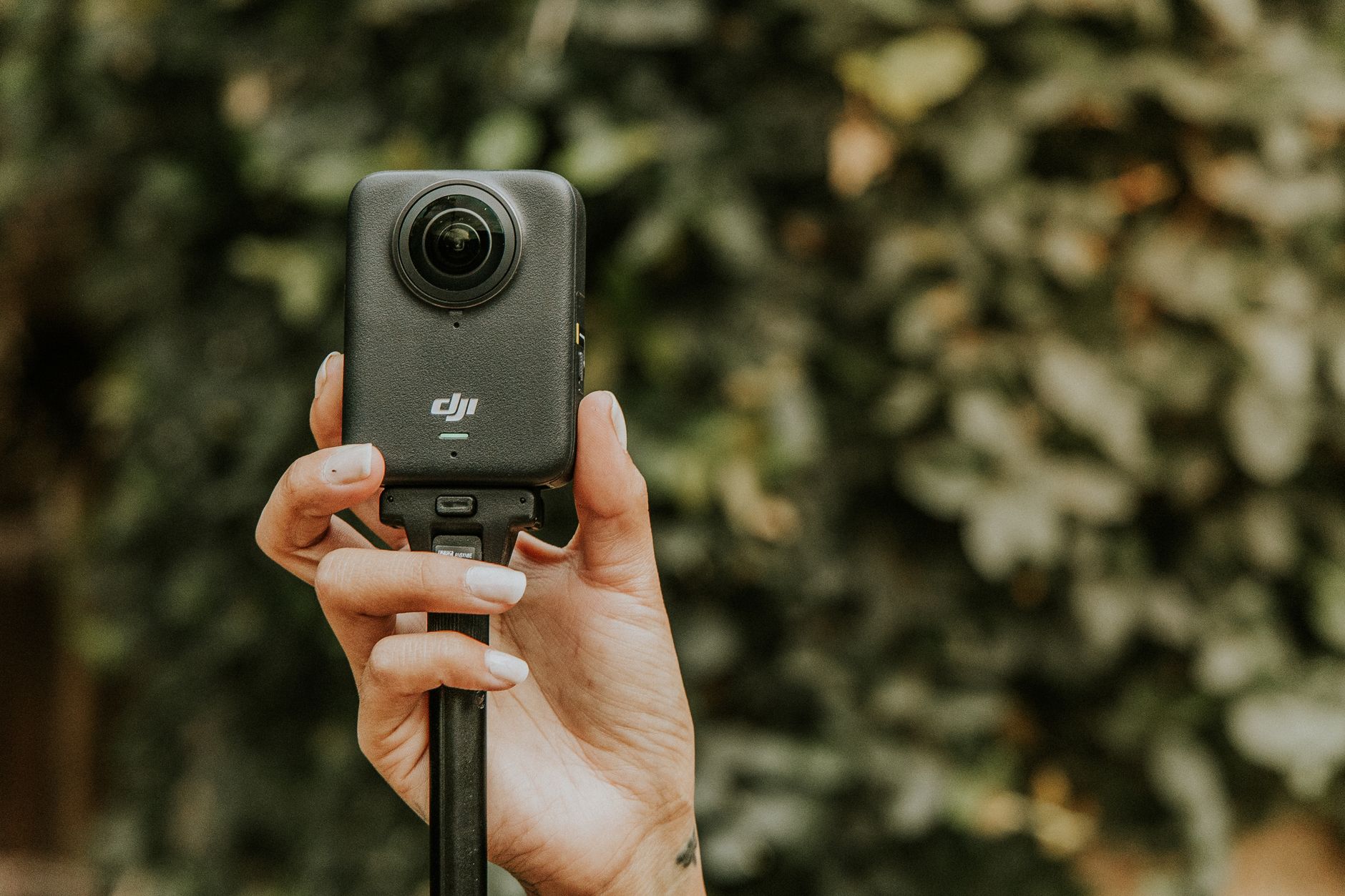
360-degree video puts the viewer inside the frame rather than in front of it. That single change in perspective has consequences for how stories get told, how brands build presence, and how audiences decide what to pay attention to. The format isn't new, but its production quality, platform support, and audience adoption have reached a point where ignoring it is a real creative choice, not just a practical one.
What 360-degree video actually is
A standard video frame is a rectangle. A director decides what sits inside it, and the viewer has no say. 360-degree video captures the full sphere around the camera, typically using a rig of lenses stitched together in post-production. The viewer then controls their own field of view, whether through a headset, a phone's gyroscope, or a click-and-drag interface on a desktop browser.
The distinction matters for production. In a conventional shoot, a cinematographer composes a shot. In a 360-degree shoot, there is no shot to compose in the traditional sense. The entire environment has to work from every angle, which means lighting rigs, cables, and crew can't hide off-frame. They don't exist off-frame. Every production decision that normally happens in pre-production or the editing suite now has to happen on set, before the camera rolls.
This is the reason 360-degree video has a steeper learning curve than most emerging formats. It isn't just a camera upgrade. It's a different way of thinking about space.
Where brands are using it seriously
Real estate was an early adopter and remains one of the clearest use cases. A 360-degree walkthrough of a property lets a buyer form a spatial understanding that no flat image or edited tour can replicate. The same logic applies to hotels, event venues, and retail spaces where the physical environment is itself part of the value proposition.
Travel and tourism brands have used 360-degree video to let audiences experience destinations before booking. Tourism Australia, for instance, has produced 360-degree content for platforms including YouTube and Meta's video channels, placing viewers inside the Great Barrier Reef or on the rim of Uluru. The goal isn't entertainment. It's pre-purchase simulation.
Training and education represent a quieter but commercially significant application. Medical training, emergency services preparation, and industrial safety inductions all benefit from placing a trainee inside a scenario rather than describing it. The sense of presence changes how information is retained. Research from the University of Maryland published in the journal Frontiers in Virtual Reality found recall was measurably higher in immersive video conditions compared to flat-screen equivalents, though the effect size varies depending on task complexity.
The storytelling problem
360-degree video introduces a storytelling challenge that conventional film grammar doesn't prepare you for: the viewer might be looking the wrong way.
In a standard film, the edit directs attention. A cut to a close-up, a sound cue timed to a reveal, a camera push toward a subject: these are tools for managing where the audience looks and when. In a 360-degree environment, the viewer can look anywhere. They might be studying the wallpaper in the background while the story-critical action unfolds to their left.
Productions that handle this well use spatial audio as a guide. A voice, a sound effect, or a musical cue coming from a specific direction pulls the viewer's head toward the intended point of focus. Some productions use subtle visual prompts, arrows or light flares, though heavy-handed guidance can break the sense of immersion the format is built on. It's a narrow line to walk.
This is also why 360-degree storytelling tends to favour presence over plot. Documentary and experiential content, where the viewer absorbs an environment rather than tracking a narrative, suits the format better than scripted drama. The technology rewards curiosity more than it rewards attention.
Platform and hardware realities in 2026
YouTube and Meta's platforms both support 360-degree video natively, and both have done so for several years. YouTube 360 allows creators to upload equirectangular footage with a simple metadata tag, and the platform handles the interactive player automatically. That removes one of the historic barriers to distribution.
Headset penetration remains the sticking point. Meta Quest 3 and Apple Vision Pro have expanded the installed base of capable devices, but the majority of 360-degree video is still consumed on phones or desktop browsers. This matters because the experience is fundamentally different across those surfaces. A phone held in two hands and physically rotated to explore a scene is genuinely immersive. A browser player navigated with a mouse cursor is not.
Productions that don't account for this split end up optimising for the headline use case (headset) while the majority of their actual audience uses a diminished version. The smarter approach is to design for the phone-based experience first and treat headset viewing as a premium layer on top.
Production considerations worth knowing
Stitching is where most 360-degree productions lose quality. The seams between lens captures have to be resolved in post, and errors appear as distortion, ghosting, or misaligned parallax. Stitching software has improved considerably, but the quality of the result is directly related to the quality of the capture: steady camera position, controlled lighting, and consistent exposure across all lenses. Shooting in variable natural light creates inconsistencies between lenses that software struggles to reconcile cleanly.
Audio is often underweighted in 360-degree planning. Spatial or ambisonic audio, where sound is encoded with directional metadata, is what makes immersive video feel genuinely three-dimensional. Standard stereo audio in a 360-degree environment sounds flat and breaks the sense of presence immediately. A production budget that prioritises the camera rig but skimps on spatial audio microphones is building half the experience.
Post-production timelines are longer than most clients expect. Stitching, spatial audio processing, colour grading across multiple footage streams, and final encoding to equirectangular format all add time. A typical short-form 360-degree piece takes roughly 40 to 60 percent longer to post than a comparable flat video, depending on scene complexity.
How it connects to broader video strategy
360-degree video isn't a replacement for conventional production. It's a specific tool for specific problems. The question worth asking before commissioning a 360-degree project is whether the viewer's perspective is itself part of the value. If the answer is yes, the format earns its extra cost and complexity. If the content would work just as well in a standard frame, the conventional approach will deliver a cleaner result.
For brands already thinking about how short-form video shapes their digital content strategy, 360-degree content occupies a different part of the funnel. Short-form earns attention at scale. Immersive 360-degree video earns depth of engagement from a smaller audience who are already interested enough to lean in. Both have roles, but they don't substitute for each other.
Studios considering immersive formats should also factor in how the content will be discovered. The platforms that support 360-degree playback don't surface it differently in algorithmic recommendations, so the discoverability principles that govern metadata and streaming platform discoverability apply here just as they do to any other video type. The immersive quality gets the viewer to stay. Getting them there still depends on titles, thumbnails, and tags.
The format has earned a permanent place in the production toolkit. It's not the future of all video. It's a precise instrument that, used in the right context, does something a flat frame never can.